Barcelona Code School

Since 2015 / 500+ graduates
UX/UI Design Bootcamp with AI in Barcelona Code School

UX/UI Design Bootcamp with AI in Barcelona Code School

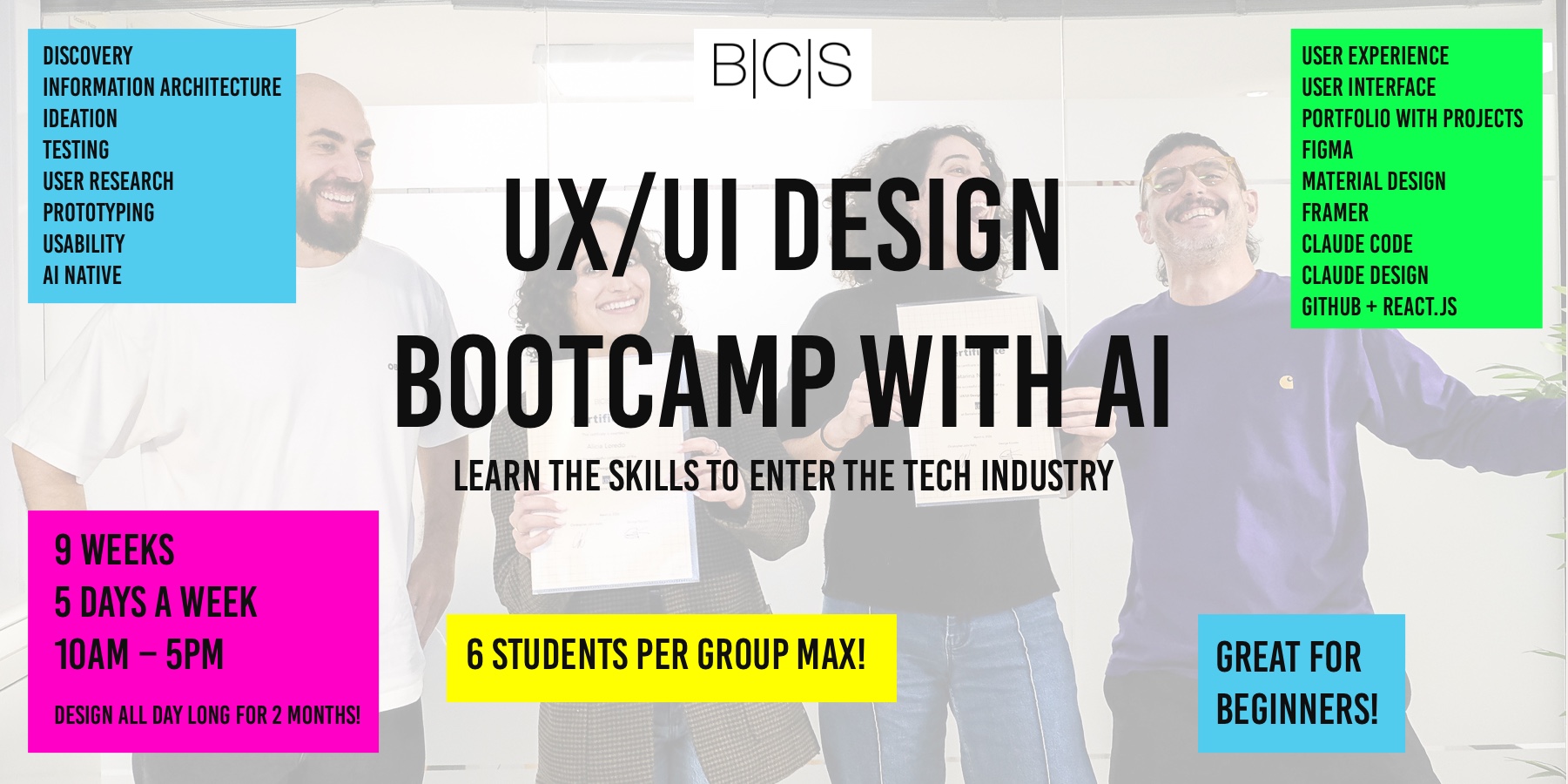
9 weeks, full-time. On campus or remote live.

Learn the complete UX process - research, definition, prototyping, testing, iteration - and learn it the way design teams actually work in 2026: with AI in every step of the workflow.

Four real sprints. Seven theory modules. A dedicated AI module covering prompt and context engineering, Claude Code, MCP and quality control.

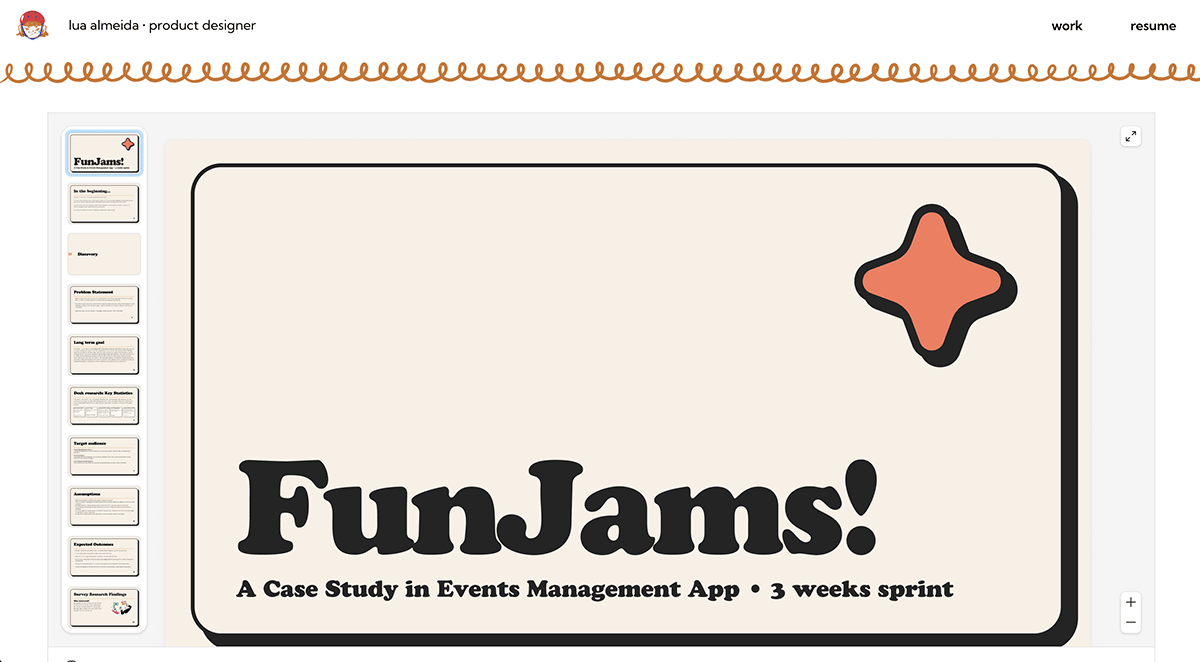
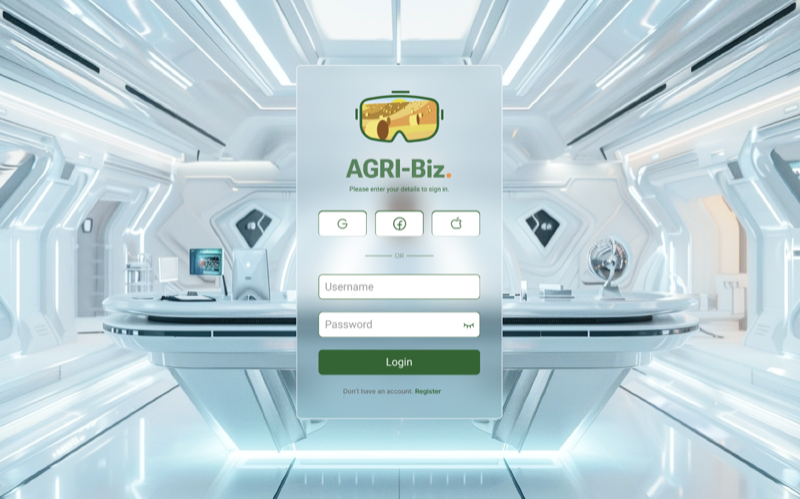
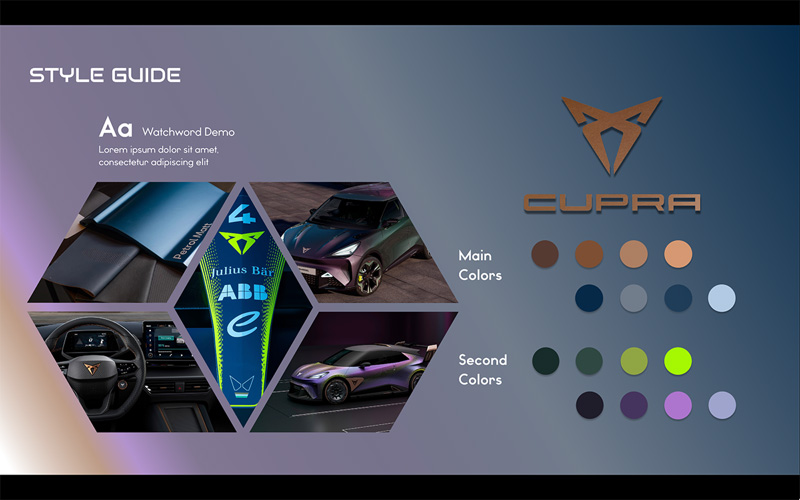
You finish with four case studies and a live portfolio website you built and shipped yourself.

The toolchain you will actually use

  • Figma and FigJam AI - the core of the craft
  • Claude - research synthesis, interview analysis, critique
  • Claude Code - real prototypes and production-ready front-ends
  • Claude Design - concept and hi-fi generation you can steer
  • Framer AI - shipping your portfolio site
  • Figma AI - automating repetitive design tasks
  • MCP integrations - connecting AI to your design data
  • Notion and Google Forms for research operations
  • GitHub and React.js for your prototypes and portfolio

Tools change. The reason we teach a stack, and the judgement to pick the right tool per phase, is so you can swap any one of them out and keep working.
Course format

  • 9 weeks of intensive hands-on training
  • Full-time program, Monday to Friday, 10:00 to 17:00 CET
  • Small groups (max 6 students)
  • On campus in Barcelona or remote live
  • Every week is a self-contained sprint: Monday brief, Friday presentation
  • In English
  • Career support: CV, portfolio, and interview preparation
  • Industry-recognized certificate
  • Scholarships available

Why this course exists

The UX job market changed shape. "AI-assisted design workflows" moved from a nice-to-have line on a CV to something hiring managers ask about in the first interview.

Figma's State of the Designer 2026 reports that the large majority of designers now use generative AI in their daily work and say it improves the quality of their output. A designer who cannot work this way is competing at a permanent disadvantage - against candidates who ship three concepts in the time they ship one.

But the opposite failure is just as fatal. Portfolios full of generic AI output - no research, no testing, no point of view - get rejected instantly. Hiring managers can spot them in seconds.

This bootcamp is built for the space between those two failures: rigorous, evidence-based UX methodology, executed at AI speed, with the quality control to prove the thinking is yours.

What makes this different from a traditional UX bootcamp

AI in the process, not bolted on

There is no single "AI week". Every sprint uses AI at the step where a working designer would actually use it - and skips it where a human still does it better.

You do real research

Site visits, real interviews, usability sessions with actual strangers. AI helps you synthesize the data. It does not get to invent it.

Anti-slop quality rubrics

An explicit method for keeping generated work specific, branded and accessible - and for spotting when a model has produced something plausible but empty.

A full week on writing case studies

Most portfolios fail on the write-up, not the pixels. Week 5 exists only to turn your work into stories a hiring manager will read to the end.

You build and ship your own site

Not a template on a portfolio platform. You develop your portfolio website with Framer AI or Claude Code, and it goes live in week 9.

Friday presentations, every week

Nine weeks means nine presentations to an audience. By graduation, defending your design decisions out loud is a reflex, not a fear.

Get the syllabus now

What our graduates say

I had an amazing time at Barcelona Code School. Anyone who is looking for intensive and proactive course I would really recommend it, it helps you to be ready for the job market!

– Getter Mizer

My time at Barcelona Code School was life changing in the best way. Chris is so knowledgeable, kind and talented, and his constant encouragement really highlighted my strengths, and inspired me to face (and overcome) my fears as a newbie UX/UI designer. He never allowed me or my fellow students to indulge in self doubt, and I believe it's because of this that we were able to overcome any design challenges we encountered in the most fun and meaningful way.

It was truly a pleasure to have him as an instructor and I'll forever be grateful for his constant encouragement, and for believing in me from day one and even after completing the program. He also has an awesome sense of humour and excellent music taste! A big thank you to the BCS team ☺️☺️ I too highly recommend this course!

– L Mumba

I completed a 9-week UX/UI Design Bootcamp Course at Barcelona Code School, and it exceeded my expectations. The course transformed my design thinking and approach. The teaching methods were excellent, and I learned a lot.

A special thanks to my instructor, Chris Kelly—he’s patient, dedicated, and ensures every student understands and applies the material effectively.

I highly recommend this course and the amazing team at Barcelona Code School!

– Bayan A

Overview

Over nine weeks you run a structured UX process four times over - from user research and problem definition through prototyping, usability testing and iteration - on four different kinds of problem: a service, a startup product, a wicked systemic challenge, and a project of your own choosing.
Alongside the sprints, seven theory modules take you from the foundations of human-computer interaction through design psychology, methodology and business strategy, ending with a full module on AI integration, ethics and advanced workflows.

This course is perfect for:

  • Those transitioning into a UX/UI design career who want a skill set that matches how teams hire right now
  • Teams who want to learn advantages of UX Design process implementation with current AI tools to improve their products or services
  • Visual and graphic designers who want to move beyond aesthetics into research-backed, validated design decisions
  • Developers, product managers and marketers who want to own the user-centered part of product work
  • Entrepreneurs who want to validate ideas and design products people actually need - fast
  • Designers already working who feel their AI workflow is improvised and want a professional method behind it

Four sprints, one portfolio: week by week

Every week is a self-contained sprint with a Monday brief and a Friday presentation. Click a week to open it.

Week 1: Discovery - Service Design - Part One

Week 2: Business Week - Lean Startup Project - Part One

Week 3: Test the Design - Service Design - Part Two

Week 4: App Design - Lean Startup Project - Part Two

Week 5: Write-Up Week - Case Study

Week 6: The Wicked Project - High-Stakes Sprint

Week 7: Research and Definition - Personal Project - Part One

Week 8: Build and Test - Personal Project - Part Two

Week 9: Portfolio Week - Ship It

Cornerstone modules

A structured learning path that runs alongside the sprints, taking you from foundational human-computer interaction principles to advanced AI workflows and business strategy.

Module 01: Beginnings and Disciplines

Understanding the origins, scope and core disciplines of user-centered design.

  • Design origins
  • Don Norman's affordances
  • What is User Experience Design
  • What is User Interface Design
  • What is Service Design

Module 02: Fundamentals of HCI and UX

Core theoretical principles, data handling and recognizing design failures.

  • Human-computer interaction
  • Key figures in the field
  • Working with data
  • What is bad UX

Module 03: Design Psychology and Human Behavior

Cognitive principles, heuristics, decision-making and ethical boundaries in design.

  • Mental models
  • Gestalt and the Laws of UX
  • Nielsen heuristics
  • Decision making
  • Emotional design
  • Bias
  • Dark patterns

Module 04: Frameworks and Methodologies

Structured approaches to innovation, problem-solving and iterative product delivery.

  • The scientific method
  • Design thinking
  • Lean Startup
  • MVP workflow
  • Wireframing workflow
  • Information architecture

Module 05: Technical UX and Research Skills

Hands-on qualitative and quantitative research techniques for generating user insight.

  • Empathy mapping
  • Non-directive interview technique
  • UX survey writing
  • Running a usability testing session

Module 06: Business Analysis and Product Strategy

Real-world business case studies, market disruption and strategic design impact.

  • The death of Kodak
  • A case of genius
  • Reading a business model as a designer

Module 07: AI Integration, Ethics and Advanced Workflows

Cutting-edge artificial intelligence, prompt and context engineering, accessibility and modern design workflows.

  • Advanced prompt engineering frameworks
  • Context engineering, token economics and dynamic window management
  • Working with inspiration and multimodal visual loops
  • Workflow with Claude Code, MCP integrations and deterministic hooks
  • Working with Skill.md, Claude.md and progressive context disclosure
  • Avoiding AI generic design slop: the rules and quality rubrics
  • Automated verification, LLM-as-a-judge and testing loops
  • Ethics, bias, guardrails and accessibility

Module 07 in detail: AI Integration, Ethics and Advanced Workflows

This is the part of the curriculum that does not exist in a traditional UX bootcamp - and the part that makes the difference in an interview.

AI: 01 Advanced prompt engineering frameworks

Move beyond basic prompting. Chain-of-thought, few-shot learning, role-based prompting and structured output formats - how to write prompts that produce consistent, high-quality design output instead of lucky one-offs.

AI: 02 Context engineering, token economics and dynamic window management

Understand the mechanics of model context windows. Optimize what you feed the model, manage conversation history, and build context systems that stay coherent across a long design project.

AI: 03 Working with inspiration and multimodal visual loops

Use AI for visual exploration properly: feedback loops between text prompts and visual output, with the model as a collaborator in ideation and moodboarding rather than a slot machine.

AI: 04 Workflow with Claude Code, MCP integrations and deterministic hooks

Integrate AI coding assistants into the design-to-development pipeline. Use Model Context Protocol integrations and deterministic hooks so your outputs are reproducible, not improvised.

AI: 05 Working with Skill.md, Claude.md and progressive context disclosure

Structure project knowledge so an AI can actually use it. Progressive context disclosure, project instruction files, and team knowledge management that survives beyond one chat session.

AI: 06 Avoiding AI generic design slop: the rules and quality rubrics

The single biggest reason AI-assisted portfolios get rejected. Build explicit rules and quality rubrics that keep generated work specific, branded, accessible and yours.

AI: 07 Automated verification, LLM-as-a-judge and testing loops

Build verification pipelines that use models as evaluators - catching errors, validating design consistency and maintaining quality at scale instead of eyeballing every screen.

AI: 08 Ethics, bias, guardrails and accessibility

The ethical dimensions of AI in design: algorithmic bias, fairness in generated output, why human oversight is non-negotiable, and how to keep AI-enhanced products accessible to everyone.

The outcomes

  • Be ready to apply for UX/UI and product design roles - and to answer the AI-workflow question properly.
  • Design user-centered digital products using a full UX process - research, definition, prototyping, testing, iteration.
  • Run real user research: non-directive interviews, surveys, usability testing sessions - and defend the findings.
  • Use AI across the entire design workflow: prompt and context engineering, multimodal visual loops, AI-assisted synthesis and prototyping.

  • Build working prototypes with Claude Code and Claude Design, and ship a real website with Framer AI.

  • Apply quality rubrics and automated verification so your AI-assisted work is specific, accessible and defensible.
  • Make design decisions in business language - Lean UX Canvas, Business Model Canvas, DVF analysis.
  • Graduate with four case studies and a live portfolio website that show how you think, not just what you made.

What you graduate with

Case study 1 - Service design

A two-week sprint on a real service: as-is journey mapping, service blueprint, benchmarking, hi-fi prototype and public usability testing.

Case study 2 - Lean startup product

A business-driven app design: Lean UX Canvas, Business Model Canvas, survey and interview research, personas, preference testing and DVF analysis.

Case study 3 - The wicked project

A high-stakes systemic challenge tackled with design thinking, Claude Code and Claude Design, ending in a concept pitch.

Case study 4 - Your personal project

Two weeks on a topic you choose, with your own research methodology, information architecture, design system and before-and-after iteration evidence.

A live portfolio website

Site-mapped, styled and developed by you with Framer AI or Claude Code, hosted and online by the last Friday.

A documented AI workflow

Your own Claude.md and Skill.md project files, prompt frameworks and quality rubrics - a reusable working method, not a folder of chat logs.

Scholarships

If you fall into one of these categories your tuition would be reduced by 500€

Students over 40: because we know it’s harder to commit to learning at a certain age and we are willing to help.

Women in tech: we're proud to say that 45% of our graduates are women, and we're committed to achieving full gender equality. This is especially significant given that less than 9% of women work in tech, according to this StackOverflow industry survey.

How to get a scholarship:

After signing up online you will get a student's form to fill out where you can select the applicable scholarship. Your final tuition quote would be calculated based on that and you will get links for making the remaining payments.

Financing

We can assist in getting a student loan which usually have lower rates than consumer loans.

To do so we can send you a proforma invoice for the selected course which you can attach to the student's loan application.

Please fill out this form.

Instalment payments are available at the checkout by klarna logo and PayPal.

Enroll now and get the pre-course

Tuition

5800€

10% paid upon registration, the remaining is split in two payments due before course begins.

Instalment payments are available at the checkout by klarna logo and PayPal.

October 19 - December 18, 2026

UX/UI Design Bootcamp with AI

Starts in d h m s

On campus or remote live

9-week course, in English, full-time.

Registration prepayment 580€.

November 9 - January 15, 2027

UX/UI Design Bootcamp with AI

On campus or remote live

9-week course, in English, full-time.

Registration prepayment 580€.

January 4 - March 5, 2027

UX/UI Design Bootcamp with AI

On campus or remote live

9-week course, in English, full-time.

Registration prepayment 580€.

March 15 - May 14, 2027

UX/UI Design Bootcamp with AI

On campus or remote live

9-week course, in English, full-time.

Registration prepayment 580€.

May 17 - July 16, 2027

UX/UI Design Bootcamp with AI

On campus or remote live

9-week course, in English, full-time.

Registration prepayment 580€.

Students stories

Nicole Motivane

"Creating something that works - that's the real reward!"

Read full story.

Why Barcelona Code School?

  • Job-focused curriculum rebuilt for the AI era - not a legacy syllabus with an AI lecture added at the end.
  • Small groups of up to 6 students with the best mentor-to-student ratio.
  • Direct support from instructors who are working industry professionals.
  • Real projects, real users, and a portfolio that meets hiring expectations.
  • Access real hiring opportunities through our network of partner companies.
  • A structured path from beginner to job-ready in weeks, not years.
  • Career support - from CV guidance to interview preparation.
  • A focused, distraction-free campus in central Barcelona, or the same live classes remotely.

Why UX, and why now

AI has made it trivially cheap to produce interfaces. It has made it more valuable than ever to know which interface is worth producing.

That judgement - user research, problem definition, psychology, testing, ethics - is the part of UX that does not automate. It is also exactly what this course spends nine weeks drilling into you.

The designers doing well right now are the ones who pair that judgement with AI-speed execution. That combination is the entire point of this bootcamp.

But I don't know anything about UX...

You don't need any previous experience, and you don't need to code. The course takes you from zero to a solid, job-ready foundation in UX design.

You learn step by step - research, definition, prototyping, testing - with a clear structure and continuous guidance, and you use AI from week one, so it never becomes a scary add-on.

With small groups and personalized mentorship, you won't get stuck or fall behind.

All you need is a laptop and commitment. We'll guide you through the rest.

What if I already design, or already use AI?

If you already work in design, development or product, you'll structure what you know with real UX methodology and move from intuition to validated decisions.

And if you already use AI daily, this is where the improvising stops: context engineering, reproducible workflows, MCP integrations, quality rubrics and evaluation loops - a professional method you can bring into a team.

Students who advance faster get a more demanding track with harder briefs and direct job opportunities on graduation.

International students

You are welcome!

A lot of our students are coming from abroad. The course is in English so there is no language barrier.

If you will need help with visa we can send you an acceptance letter to attach to your visa application!

Book a call or meeting with us

If you want to have a discovery call to see which course is better for you and your goals please feel free to book a call or meeting on campus. We'd be happy to help you!

Or just call us: +34 936 639 807

FAQ

Do I need to know how to code?

No. You will use Claude Code and Framer AI to build prototypes and your portfolio site, but you drive them in plain English. No programming experience is required and none is assumed.

Is this just the normal UX bootcamp with AI lessons added?

No. The whole nine weeks were rebuilt around sprints, and AI is used inside each phase where a working designer would use it. There is also a dedicated theory module - prompt and context engineering, Claude Code and MCP workflows, quality rubrics, automated verification, and AI ethics and accessibility.

Will using AI make my portfolio look generic?

That is the single most common failure and we treat it as a core skill to avoid. You'll learn explicit anti-slop rules and quality rubrics, and every project is grounded in your own field research and usability testing - which is exactly what generic AI output can never fake.

Which AI tools will I actually learn?

Claude, Claude Code and Claude Design, Figma and FigJam with their AI features, Framer AI, and MCP integrations, plus Notion for research operations. More importantly, you learn the judgement to evaluate and adopt whatever replaces them next year.

What computer would I need?

You will need your own laptop for the classes. Mac or Windows both work.

What is the language of this course?

English.

Do I have to speak Spanish?

Not for the course. Everybody at our school speaks English. Spanish helps for living in Barcelona, but most people here speak English too.

Who is this course for?

Beginners and career changers, plus designers and product people who want a rigorous method. If you don't know what UX design is, this course is for you. If you already know what Lean UX is, even better.

Can I attend remotely?

Yes. Remote students join the same live sessions in real time with the same instructor and the same group. The only difference is that on-campus students do some of their field research and public testing together in Barcelona.

What qualification will I get?

An industry-recognized Barcelona Code School UX/UI Design Bootcamp certificate, plus - more usefully - four case studies and a live portfolio website.

Are there accommodation options for foreign students?

Make sure to check Uniplaces (use UP40BCS promo code to get 40% discount on their service fees), Spotahome and Barcelona home.

What about the cost of living in Barcelona?

Barcelona is affordable compared with other metropolitan European cities. The average cost of living for students is around 1000 euros per month - expect 500-1000€ for a room or 1000€ and up for an apartment, around 10€ for lunch in a restaurant, and 10€ for a 10-ride public transport pass.

Is there a pre-course?

Yes. We send you materials to study so you arrive prepared.

How does your price compare to other schools?

Our price sits in the lower competitive range. We keep groups small and pay for highly qualified instructors who are motivated to share their expertise, rather than spending on scale.

Inquiry about the course

If you are not a robot, how much would be 7 plus 6?

Some of the companies where our graduates work or worked

hiring partner logo
hiring partner logo
hiring partner logo
hiring partner logo
Glovo
Capgemini
Typeform
An innovation advisory firm working at the intersection of corporates and startups
Tipser is powering commerce at the point of inspiration by making any digital surface shoppable.
Barcinno is the community-driven platform sharing the stories, knowledge and events of Barcelona’s startup and tech communities.
Accenture Technology Logo
FutureFunded is a crowdfunding platform that helps women to raise money that are needed to enroll into a Web / Mobile Development Bootcamp and study at Barcelona Code School. By partnering with FutureFunded Barcelona Code School helps to  to reach equal representation of women in tech by educating high-profile female leaders and introducing them to a job market.
Metro AG, otherwise known as Metro Group, is a German global diversified retail and wholesale/cash and carry group based in Düsseldorf.
ThoughtWorks is a privately owned, global technology company with 40 offices in 14 countries. It provides software design and delivery, and pioneering tools and consulting services. The company offers Barcelona Code School graduates the opportunity to work as Graduate Software Developers.
Ayudamos a las personas emprendedoras de hoy con una nueva generación de soluciones pensadas para cubrir toda la gestión del negocio, desde las finanzas hasta los recursos humanos. Nuestra tecnología social y móvil proporciona datos en tiempo real para que puedas tomar decisiones rápidas y fundadas en cualquier momento y desde cualquier lugar del mundo. Apoyamos a las personas emprendedoras en todas las etapas del negocio proporcionándoles variedad de soluciones y servicios, soporte de expertos, experiencia e innovación. Entendemos tus necesidades y, por eso, te ofrecemos consejos y asistencia de máxima calidad cuando más lo necesites.
Revolutionizing the way publishers create, optimize and monetize their mobile websites. Marfeel’s proprietary technology gathers insightful data on user behavior and dynamically adjusts site layout to match usage patterns, optimizing user engagement and maximizing ad revenue.
GreenPowerMonitor is an international company with European headquarters in Barcelona that offers products and services in the renewable energy sector. GreenPowerMonitor offers Barcelona Code School graduates opportunity to join their Software development team.
WeFitter is data-driven wellness app that helps companies optimize employee's engagement and health. WeFitter works with companies all over the world like Banco Santander, Phone House, Reebok or Sanitas. They are backed by one of the most important wellness holdings in the world, and they aim to go global next year.
Genius Sports is a global leader in sports technology. They specialise in providing software for the collection, management and distribution of official sports data. Headquartered in London and with over 1,100 employees globally, Genius Sports is recognised as one of the fastest growing sports technology companies in the world. Genius Sports is the trusted partner to over 500 sports organisations, including some of the largest leagues and federations in world sport such as FIBA and the English Premier League. Genius Sports is offering Barcelona Code School graduates work as Junior Front-End Web Developers.
Restb.ai is an AI company that specializes in visual recognition for Real Estate. Their plug-n-play solutions automatically tag and classify property photos with industry-specific information. Thanks to our collaboration with Restb.ai we can offer you to join their team as Full Stack Engineer Intern.
Booklyng is a start-up who is changing the way hotel bookings are made online by adding real time intelligence and personalization technology to hotel websites. Booklyng is a part of the Telefonica acceleration program for start-ups (Wayra) and their offices are based in the headquarters of Telefonica, sharing a vibrant space along with other start-ups, in an extremely stimulating and enriching environment. At the moment Booklyng is looking for frontend Software Developers with very strong skills in programming, and would be happy to hire Barcelona Code School graduates.
InnoCells: We create and foster new digital ventures, collaborate with startups and corporations, and make digital strategic investments. InnoCells is one of BCS hiring partners where our graduates could take an advantage of learning MERN stack and applying obtained JavaScript and react skills.
Biings Technologies is a small software start-up currently working on our flagship product Biings, a new kind of Human Resource Management application based on wellbeing principles.
Real Mentoring for startups in seed phase.
Internship opportunities in automotive division of ALTRAN (Barcelona):
At Saltech Consulting, we are offering business process and decision management solutions for enterprises using the Pega platform. Our goal is to fix the Pega talent gap and help the enterprises to make their business processes more efficient. We are looking for software engineers who are interested in solving business problems.
A unique digital solution that connects local shops and department stores with a pool of  geo-localised taxi drivers, to carry out the delivery of small parcels in less than 60 minutes 24/7.
Syneidis’ primary mission is to help European institutions and companies protect their privacy by protecting themselves from cyber attacks, wherever they come from, and specifically to help protect their confidential data both at rest and in-transit, by commercializing a growing suite of cybersecurity products that are easy-to-use, solving the proverbial conundrum between security and usability.
Unnax.com: Power your company with our cutting-edge API payments platform and benefit from products built for optimised speed, security and strategy. Build dynamic applications with our user-friendly Banking as a Service APIs and get to market faster.
hiring partner logo
hiring partner logo
hiring partner logo
hiring partner logo
hiring partner logo
hiring partner logo
hiring partner logo
hiring partner logo
hiring partner logo
hiring partner logo